Planting Trees in the Fall: 7 Fallacies that Kill New Trees.

By Philemon John
Lead Author & Cultivator • Peer Reviewed & Soil Tested
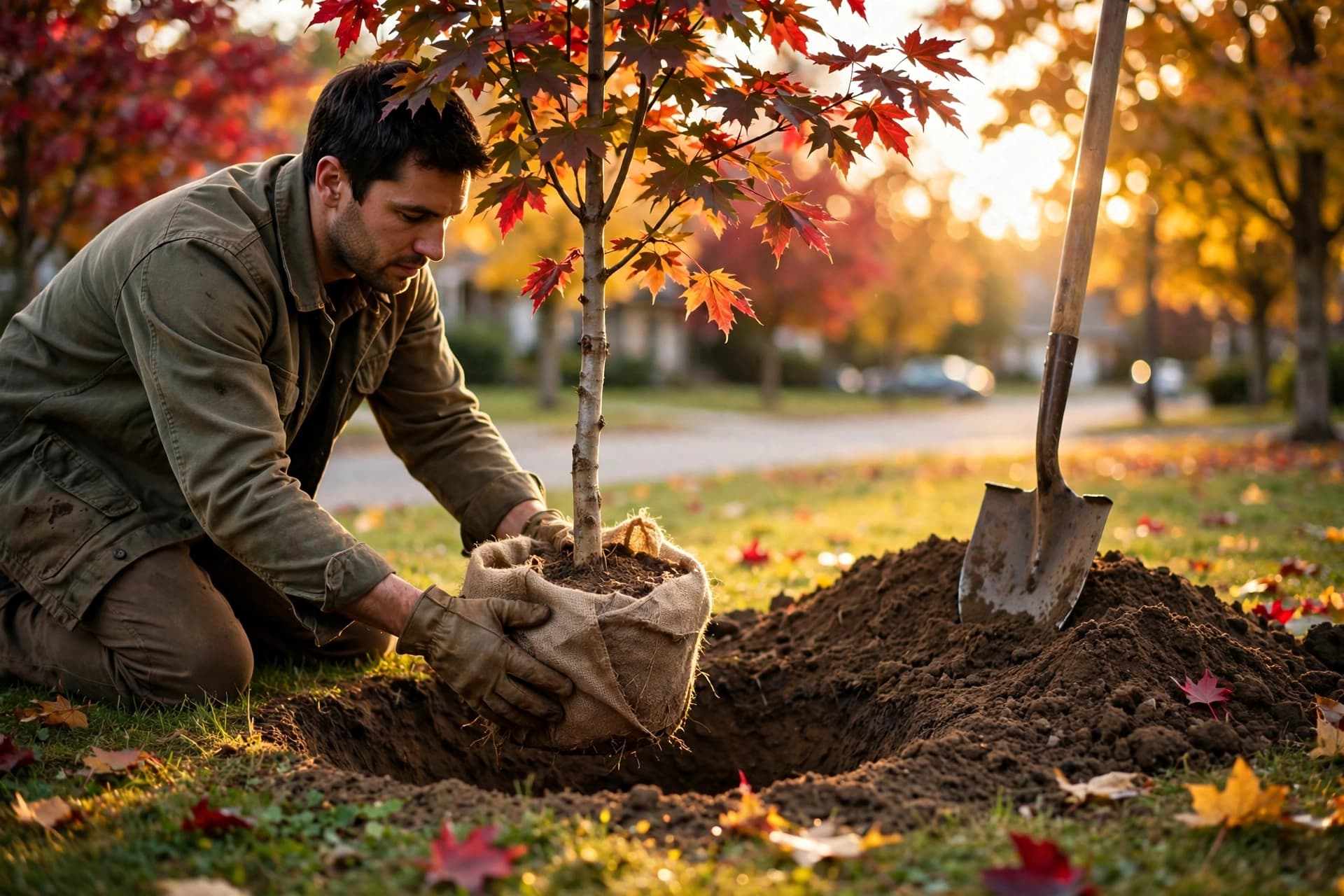
It is early October and the maples on your street are burning red, and the garden center has their trees on sale. You take one and create a hole during the weekend and feel like a hero. Then here comes spring and the leaves are never going to appear. Bad luck does not kill new trees, a list of mistakes, which can be avoided, kills them. Read on and you will find out how to avoid all seven.
Quick Answer: October is one of the best months to plant a young tree in the ground in most of the U.S., since warm soil permits the roots to grow, and the leaves are calm in cool air. To prevent loss, get at least four to six weeks prior to ground freezing, keep the trunk flare above the soil line, water by feel, lay mulch in a flat ring rather than a mound.
Why Planting Trees in the Fall Beats Spring
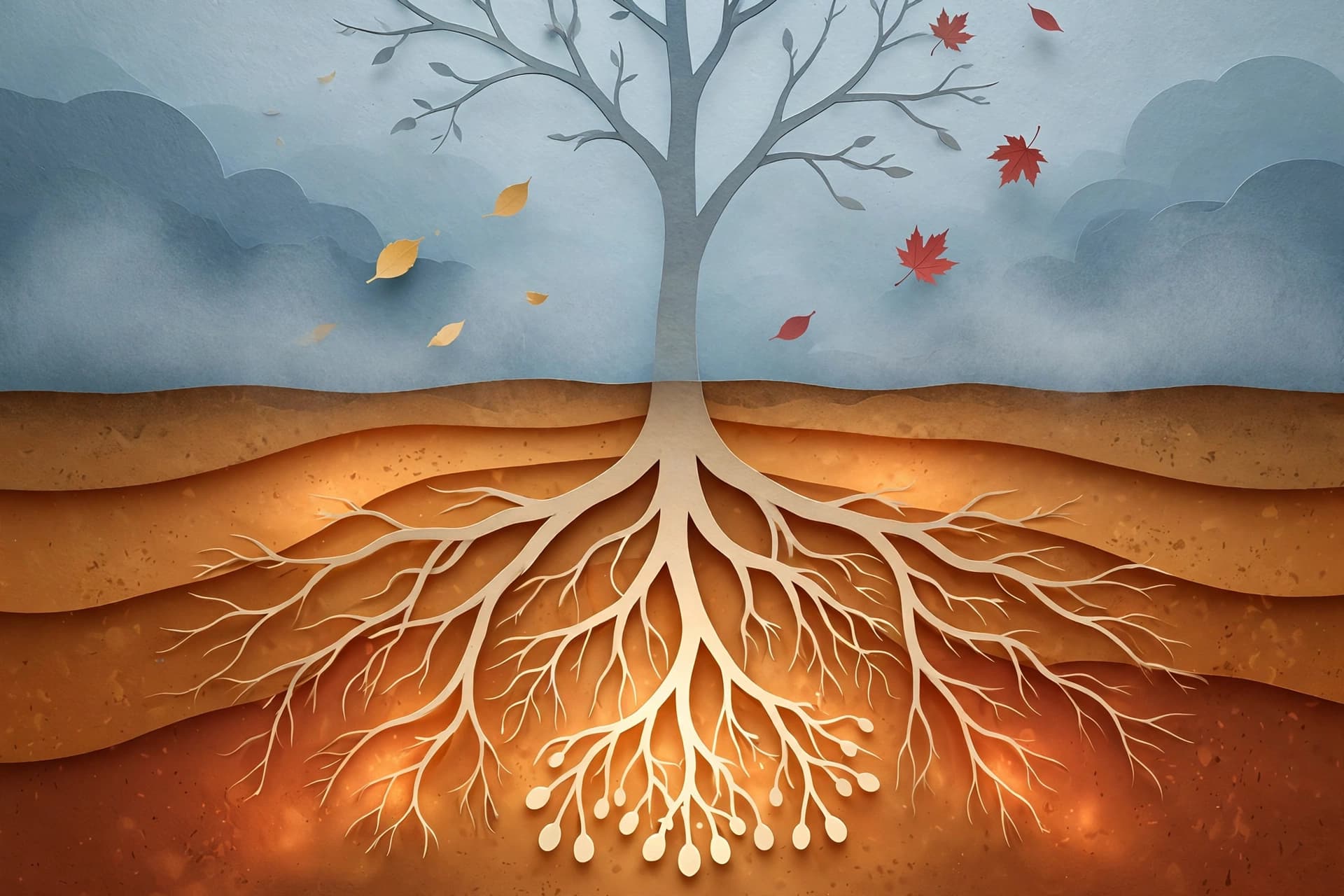
All the glory goes to spring, but a tree has the advantage of fall. The roots enjoy a head start with the leaves resting. The air becomes cooler, and leaves no longer lose much water, and the soil retains its summer warmth weeks.
It is a secret of that warm soil. Roots continue to expand until the ground gets too cold to about 40 F (Source: University extension services) and an October tree will have weeks of free root-building time before winter. It is already established by spring. An orchard tree located in the spring is required to grow roots and leaves simultaneously, and then endure initial summer heat wave.
The three planting seasons will compare to each other in the following ways:
| Season | Soil | Air | Watering demand | Biggest risk |
|---|---|---|---|---|
| Fall | Warm, cooling slowly | Cool | Moderate | Winter arrives before roots settle |
| Spring | Cold, warming up | Mild, then hot | Rising fast | Summer heat arrives before roots settle |
| Summer | Hot | Hot | Very high | Heat stress and drought |
October is the golden time in most parts of the country: the soil is still warm, the air is finally cool, and in most places, there is reliable autumn rain. It also reduces your watering chores, since the soil dries at a slower rate. And it is not only trees that love the soil of October. You can plant garlic this month as well, as you have a free afternoon.
How Late in Fall Can You Plant a Tree?
You can literally continue until the ground becomes too rocky to excavate. Practically, tree roots should have a workable soil of four to six weeks of above freezing soil, before winter to be rootbound (Source: University extension services). That window must be the longer one, as evergreens lose water whenever there is a winter.
The guesswork is removed by two quick checks. First, check the average date of the first frost in the climate data of your area on NOAA. It's a convenient reference point, as the ground normally freezes a few weeks after that date.
The rest of your yard is instructed by our guide on what to do before your first frost. Next, find your zone on the USDA Plant Hardiness Zone Map.
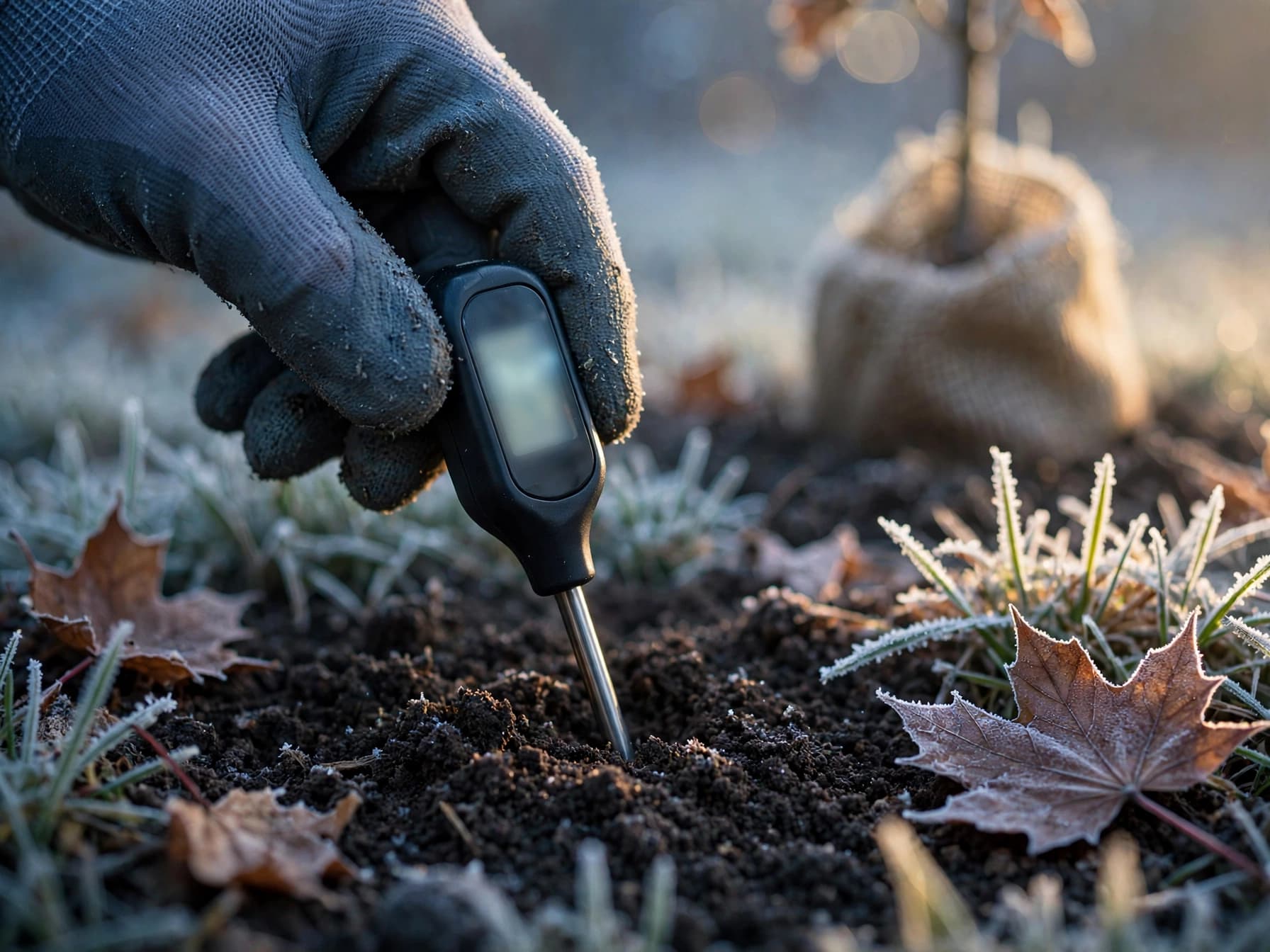
An inexpensive soil thermometer is useful, as well. When it is over 40 F some few inches below, roots are still growing. When a shovel slides down without difficulty and you squeeze a bunch of soil in your palm, then it can be done.
This is one of the starting points of your region ( Source: University extension planting calendars):
| USDA zones | Typical regions | Good fall window |
|---|---|---|
| 3–5 | Northern tier, Upper Midwest, mountain West | Early September to mid-October |
| 6–7 | Mid-Atlantic, central Midwest, Ohio Valley | October to mid-November |
| 8–10 | Deep South, Gulf Coast, Southwest, California | Late October through December |
Mistake #1: Waiting Until the Ground Is Nearly Frozen
The archetypal tree killer is procrastination. A tree planted two weeks prior to the ground freezing has hardly begun to form roots when winter closes the doors. Frost heave is the repeated freezing and thawing that may then cause shallow roots to be pushed towards the surface (Source: University extension services). When you have lost your season, wait till spring, rather than playing.
Mistake #2: Choosing a Tree That Struggles in Fall
Fall planting is not favored by all species. In colder areas, some oaks, birches, magnolias, and tulip poplars fail to establish well when planted late and in spring are usually more successful (Source: University extension tree-planting guides). Questions to ask your local extension office are what species to avoid in your locality.
And also, plants to your area, as a tree that is rated zone 7 will not be happy in zone 4 winter. After you have provided a tree, a pollinator garden planted nearby can make your tree a place where bees and butterflies can be found.
How Deep to Plant a Tree Root Flare
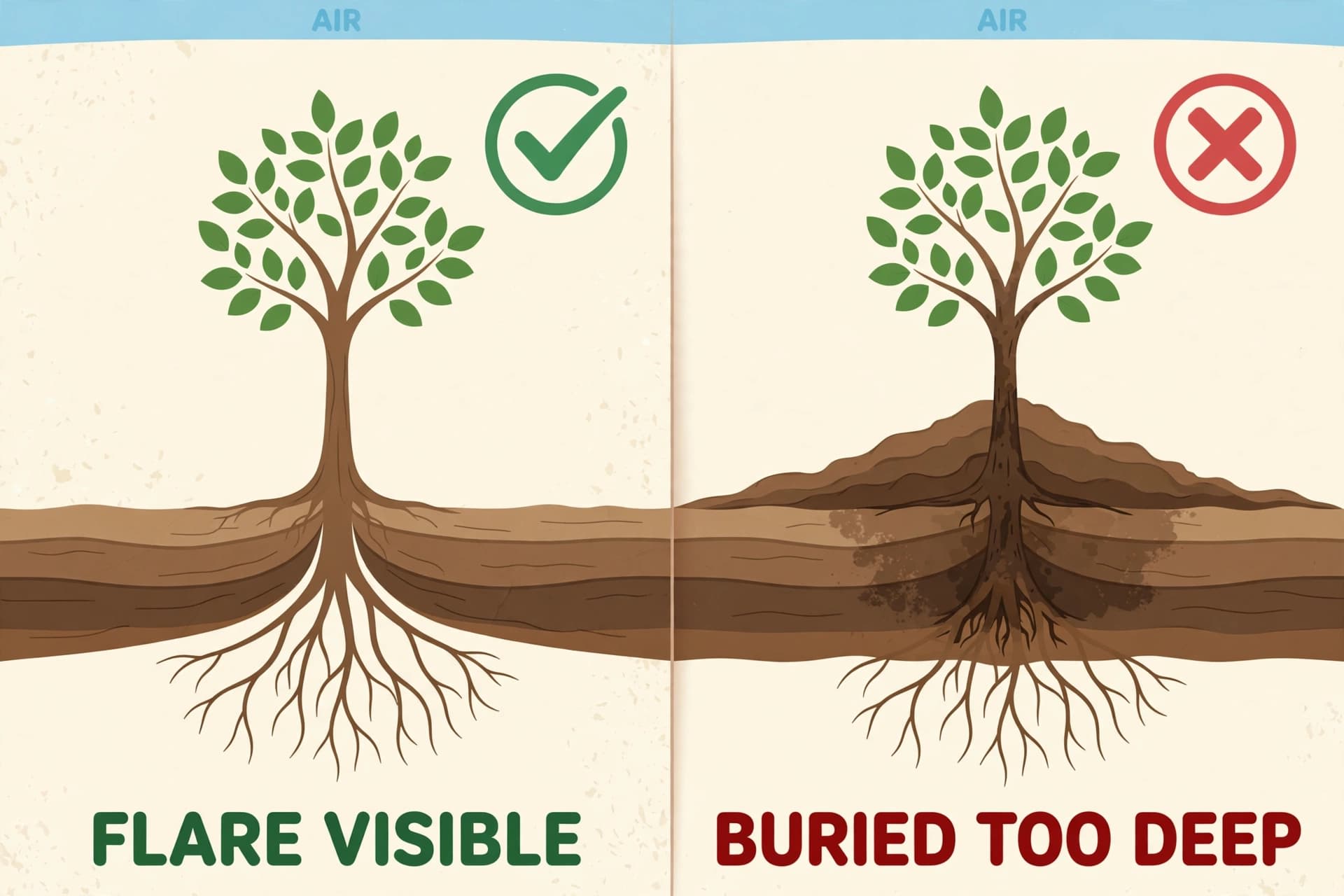
A single mistake is silently killing a great number of new trees. The point of the trunk that expands above the roots is known as the trunk flare. You can find it at or very slightly above the soil line.
Mistake #3: Burying the Trunk Flare
Planting too deep always appears in lists of the leading causes of mortality of new trees given by arborists (Source: International Society of Arboriculture). Bark that is buried remains moist, fostering rot and disease, and deep roots do not receive as much oxygen. A tree may appear to be alright last year or two and then start to degenerate without any discernible cause.
Nursery trees are usually delivered with excess soil heaped over the flare, and container trees with it buried in the potting mix. Take the brush and brush away, till you come to the point where the trunk is widening, and then measure between the flare and the bottom of the root ball. That is the amount to dig.
Enlarge the hole two or three times the depth of the root ball but not any more (Source: International Society of Arboriculture). Broad, loose soil encourages roots to expand, whereas a hole of great depth only allows the tree to sink as the soil subsides.
Where the soil is heavy, raise the flare one or two inches higher than the soil (Source: University extension services). Not sure what soil you have? Our soil, compost and fertilizer instructors can assist.
Mistake #4: Leaving Roots Wrapped, Caged, or Circling
Balled and burlapped trees are packed in twine, burlap and a wire basket, usually. The roots of container trees may be in close circles. When unattended, the two are able to strangle the trunk several years later (Source: International Society of Arboriculture).
Put the tree in the hole, first, lest you lose sight of the flare, then:
- Snip away and cut away all twine, plastic, and synthetic burlap.
- Pull natural burlap back out of the top of the root ball.
- Trim off as much wire basket as possible.
- Circle roots of container trees, loosen or cut, and divided out.
Always take the tree by its root ball and not by the trunk.
How Often to Water a Newly Planted Tree in Fall
Fall can fool you. The presence of cooler days causes the soil to appear wet and, thus, many gardeners stop watering by Halloween. But young roots must have constant water till the ground freeze.
Mistake #5: Guessing Instead of Checking the Soil
Immediately after planting, water deeply and slowly. Subsequently inspect the soil twice a week during the first month by pushing finger or trowel approximately three inches down around the root ball (Source: University extension services). On average, that amounts to one thorough soaking a week, with an addition of water in hot, dry, windy seasons.
To begin with, apply an average of 10 gallons per inch trunk diameter with each watering (Source: University extension services). The quantity of galvanized per tree with a 2-inch trunk is approximately 20 gallons. A dribble with a hose or a dribble with a watering bag pounds a quick blast, since the water does not run off, but penetrates.
An inexpensive rain gauge is helpful, as well. Once you have had an inch or more of soaking rain, you may be able to skip that week of watering.
Reading what you find: This is how:
| What you feel 3 inches down | What to do |
|---|---|
| Dry and crumbly | Water slowly and deeply |
| Cool and slightly damp | Wait a day or two, then check again |
| Soggy or muddy | Skip watering and check drainage |
Wet soil is as harmful as dry soil, since roots require air. Water till the ground is frozen and evergreens a final deep watering just before it freezes (Source: University extension services).
Mulch Volcano Around Tree Trunk: Why It Hurts and How to Fix It
When used properly, mulch is wonderful. It retains water, regulates the temperature of the soil, and prevents the weeds to compete with the young roots (Source: International Society of Arboriculture). The problem begins when piled in the wrong spot.
Mistake #6: Piling Mulch Against the Bark
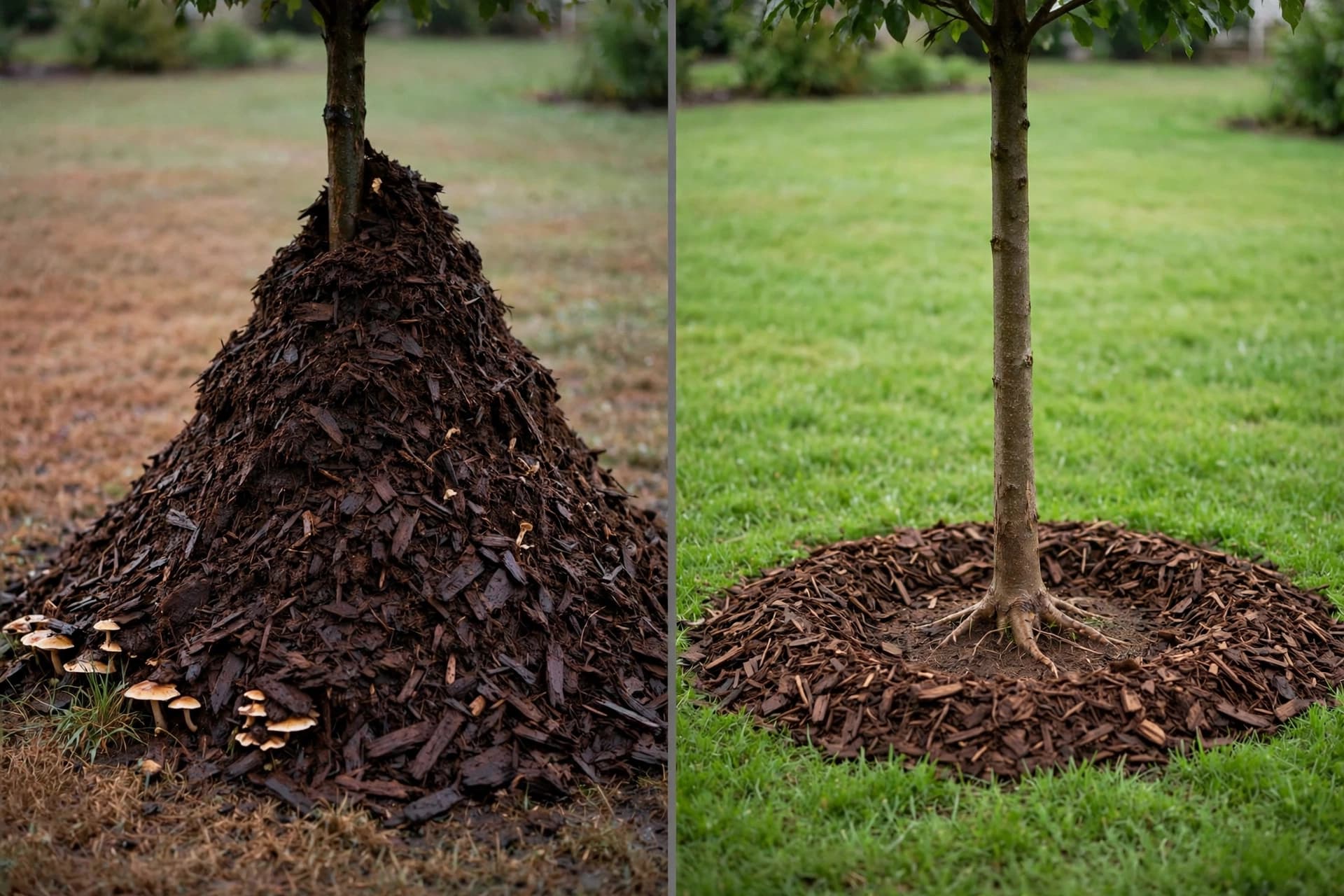
Those are handsome, cone-shaped heaps that are clean, yet, trouble. Mulch piled against the bark is damp right next to the trunk and can rot, harbor insects and rodents and even cause roots to grow upwards into the pile and around the trunk (Source: International Society of Arboriculture). The mulch is not to cover the trunk, but the roots.
The Right Way To Mulch.
- Apply mulch 2-4 inches in depth (Source: International Society of Arboriculture).
- The ring should be at least 3 feet in diameter; larger is preferable.
- Retain mulch 2 to 3 inches away the trunk to leave the flare in view.
- Shredded bark, wood chips or shredded fall leaves are free.
Have you already a cone-shaped mound? To-day put it up again into a flat, doughnut-shaped ring. It will only take five minutes and may save the tree. Mulch will settle with time; thus cover it up during autumn and maintain the doughnut shape.
How to Plant a Tree Step by Step in Fall
A final error occurs when the hole is filled. Then we will put the entire process in place.
Mistake #7: Fertilizing and Over-Amending at Planting Time
It is generous to feed a new tree, fall feeding is counter-productive. Nitrogen may cause young growth which will be killed by frost and heavy fertilizer may scald young roots (Source: University extension services). The majority of extension guides recommend waiting until the tree is completely through a growing season.
By-pass the rich compost pocket, too. A hole that is filled with soft, cemented soil and has heavy clay around it may resemble a bathtub where water is locked up, and roots are not allowed to go out (Source: University extension services). Instead fill in with the dug-out soil.
Check what is really in the bag when you do start feeding later. Store lawn winterizer on the lawn and not in the planting area of the tree.
Your 8-Step Fall Planting Checklist
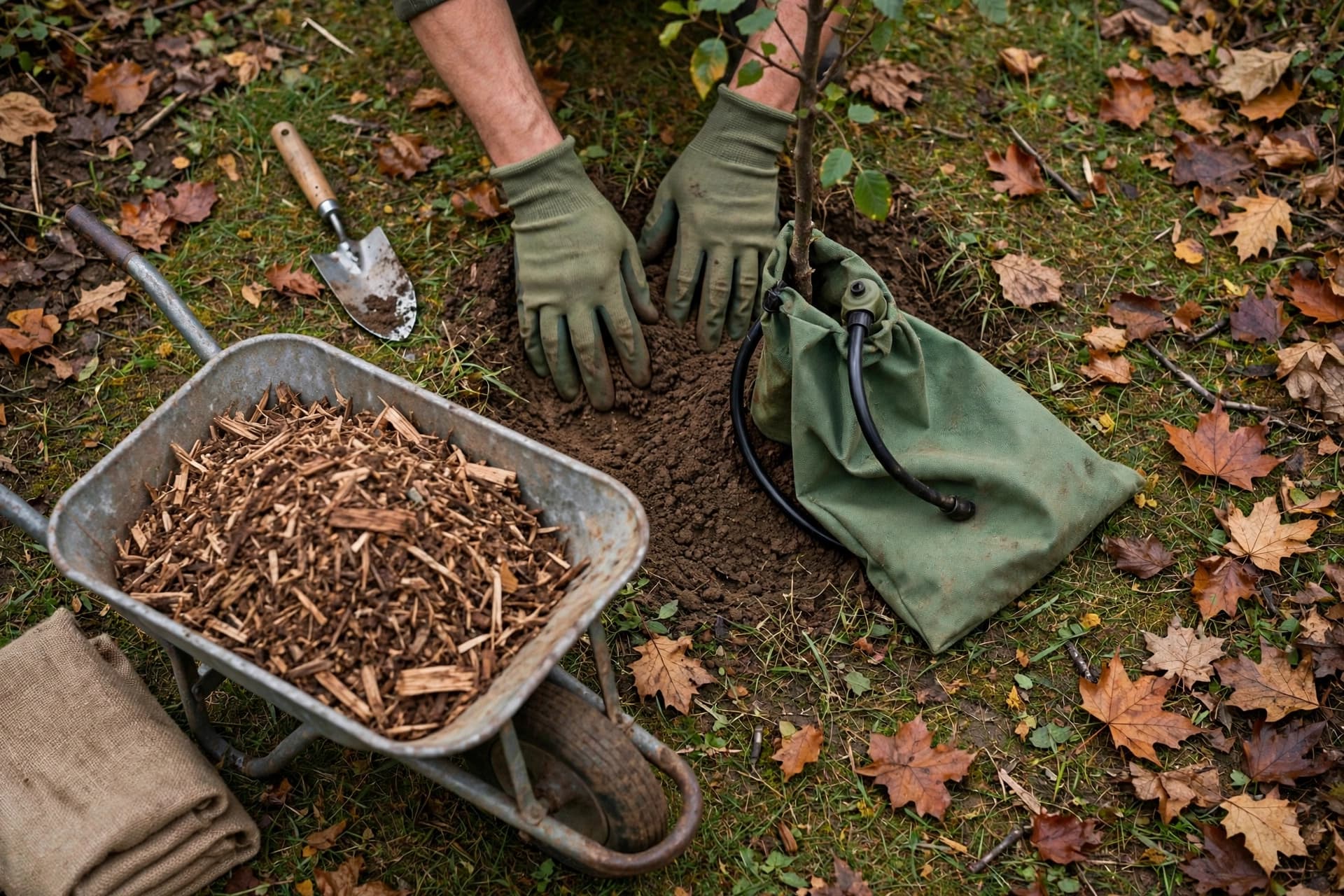
The entire process is as follows:
- Check the clock. Make sure you have four to six weeks till the ground freezes.
- Pick the spot. Look up towards power lines and allow the tree to grow to full size.
- Find the flare. Blow off any additional soil and count the distance along the flare to the root ball bottom.
- Dig wide, not deep. Poke two or three times the width of the root ball, and smooth sides of clay roughly.
- Prep the roots. Take out twine, plastic and wire and loosen any roots circling.
- Set and backfill. Use the root ball to lift up, keep the tree straight on solid ground, replace with native soil, and water, as you go, to settle air pockets.
- Mulch in a ring. Sprinkled 2 to 4 inches, not touching the trunk.
- Water and watch. Gradually soak, and then test the soil twice a week until ground is frozen. Stake when the tree is not able to stand.
Avoid heavy pruning during planting. Take away only dead or diseased branches as the leaves nourish the tree (Source: International Society of Arboriculture).
References:
- Planting Trees in Fall, North Dakota State University Extension. Covers fall planting timing, root-collar height, the weekly watering rule of thumb, fertilizer timing, and mulch ring size.
- Watering Newly Planted Trees and Shrubs, University of Minnesota Extension. Covers watering frequency and amounts for new trees.
- Planting Trees in Landscapes, University of Kentucky Cooperative Extension (PDF). Covers fall planting benefits, hole width and depth, and mulch mounds.
- Trees: Planting and Watering, University of Nebraska–Lincoln Extension (PDF). Covers the root flare and the problems caused by planting too deep.
- New Tree Planting, International Society of Arboriculture (PDF, hosted by the City of Boise). Covers planting height, mulching, and light pruning at planting. More free tree-care guides are on TreesAreGood.org.
- Tree Planting 101, Massachusetts state government (PDF). Covers flare position, hole depth, and the problem with mulch volcanoes.
- Caring for New Trees, Massachusetts state government (PDF). Covers watering, the 3-3-3 mulch method, skipping fertilizer, and pruning only dead or broken branches.
- USDA Plant Hardiness Zone Map, USDA Agricultural Research Service. Covers zone ratings.
- NOAA National Centers for Environmental Information. Covers average first-frost dates.
- USDA National Institute of Food and Agriculture. Use it to find your local Extension office.
Final Thoughts: Give Your New Tree a Strong Start
Warm soil, cool air are half the labor, and all you have to do is to prevent the seven errors: time it, use the right species, keep the flare in sight, manipulate the roots, water by feeling, mulch in a ring, and hold the fertilizer. Do so, and your tree is much more likely to prosper next spring. When you are in fall mode, you can read our guide on when to apply winterizer fertilizer and you will be prepared before your lawn goes into dormant.
Frequently Asked Questions
Is planting trees in the fall better than planting in spring?
How late in fall can you plant a tree in a cold climate?
How often should you water a newly planted tree in fall?
Is a mulch volcano around a tree trunk ever okay?
Should I fertilize a tree I just planted in fall?
Do I need to stake a tree after planting it?
About Philemon John
Philemon John is the Lead Author of Broad Gardening and has more than 10 years of experience growing and caring for plants in the backyard. He is particularly passionate about vegetable gardening, soil building and pest management and offers real-life advice and tips to support home gardeners.